All posts by Janet Coburn

When I Grow Up I Wanna Be a Colorista

Remember when everyone was having their colors done and what you wore depended on whether you were Summerfall Winterspring? (Bonus points for getting that reference.) I don’t think people do that so much anymore, but I do know there’s a whole lot of money to be made in the world of color. And I don’t just mean adult coloring books, which were a thing, but I think are over.
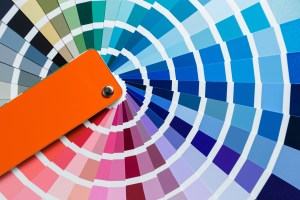
For this to make any sense, you have to know about Pantone. Pantone is a color system that allows people to make different shades out of their basic components: black, red, yellow, and cyan. (Cyan is a fancy word for a certain shade of blue.) Those are the colors that make up all the other colors that appear, for example, in magazines, in clothing, and just about everywhere else. 

Pantone has a spiffy color wheel that shows you all the Pantone colors and the formulas that make up each one. Even better, once a year Pantone gets to pick a “color of the year” that everyone will be wearing and splashing all over their products and signs and so forth. This year, they got a little boring and chose a color called “Classic Blue,” which admittedly has the advantage that pretty much everyone is able to wear it, except maybe springs.

But where color really gets exciting is in the realm of paint swatches. My husband and I were recently picking out all-new colors for our house, and, let me tell you, Sherwin Williams has Pantone beat all hollow. The SW color book is several inches thick, with seven different shades on every page.

What’s really fun is the names for the colors. I imagine a group of coloristas sitting around and thinking up names for all the swatches. My study, for example, is going to be painted a color called Armagnac, which is a rusty sort of clay color. (Armagnac is also a kind of brandy or cognac. Some might say that I’m entirely likely to splash Armagnac all over my walls, but they’re wrong. That stuff is expensive. But I digress.)

Most of our other choices were pretty obvious. The living room is going to be lime granita, which you can probably figure out is green of some sort, though what it has to do with the frozen fruit treat I couldn’t say. The bathrooms are going to be sumptuous peach (I’m sensing a fruit theme emerging here). The kitchen will be sleepy hollow; the bedroom will be sunny veranda; and my husband’s study will be breaktime.

The ones that have me puzzled are sleepy hollow and breaktime, both of which are shades of blue. I would have thought a color called sleepy hollow would have been a muddy, ominous gray and breaktime would be the color of coffee, but no.

Most of the colors in the SW book have sensible names like decisive yellow and daisy and lemon twist, but others are a bigger stretch. Just going by names, how would a person know that “restful” is teal, “baroness” is purple, and “serape” is copper?

Personally, I would like to be one of the coloristas assigning names. No classic blue for me. I would name colors with interesting-sounding but indecipherable names like “lollipop,” “sharknado,” and “bubble wrap.” Imagine painting your kitchen “cheap perfume” and then trying to find curtains that match. Or convincing your 12-year-old that “diagonal” is a perfectly charming color for her room. “Bowling ball,” “cat’s nose,” and “overripe kiwi” would be entertaining too. Then there are the possibilities of adding adjectives to actual colors: “apathetic red,” “responsible puce,” and “sprightly brown.”

Sherwin Williams would probably fire me on my first day, but even one day as a colorista would be pretty sweet. (Idea! A paint color called “sweet patootie” or “sweet chariot” or “sweet substitute” or … !)

Filk: The Typo That Lived

Say you’re attending a convention in a nice hotel. (It doesn’t matter what kind of convention. You could be sales reps or Civil War buffs or Young Republicans.) You notice strangely clad people, both young and old, cruising the hallways and crowding the function rooms. Among them are people dressed as Imperial Stormtroopers, elves, and vampires.

Suddenly you realize that you are sharing the hotel with a science fiction convention. You pick out a normal-ish person wearing a badge and inquire, learning that your suspicions are right. Your informant smiles and tells you that the odd-looking people are “mostly harmless.” Not quite reassured, you continue on your way.

As you pass one of the function rooms, you hear singing. And instruments playing. You can pick out various guitars, a keyboard or two, perhaps some drums or a banjo. And is that a Sousaphone? As someone opens the door to enter, you glimpse a circle of people surrounded by an audience. A woman finishes singing a ballad. Then the entire crowd breaks into song, singing something they obviously all know but you have never heard before. It seems to be about Apollo 11.

What you are witnessing is a filksing.

Filking is a tradition among some science fiction aficionados. Legend has it that the name came from a typo of “folk” on a program, and it just stuck. Defining filk music is more difficult. Many have tried and many have disagreed. But at heart, filking is science fiction music.

That said, the influences on filk are many. Like folk music, it is usually (though not always) accompanied by acoustic instruments or sung a capella. Most of the songs are created by the performers themselves.

The themes of the songs are usually (though not always) based on science fiction and fantasy books, movies, media, or games; science fact, especially the space program; and geek culture generally, with room left over for outrageously bad puns, folk music icons like Stan Rogers, and Scottish ballads. Some use traditional tunes, others are wholly new, and some are parodies of popular songs. There’s even a sub-category of filk called “ose” (for ose, ose, and more-ose), featuring songs about berserker Viking warlords mourning their dead hunting hounds.

That said, the variety of possible songs is impossible to catalogue. Songs at a filk-sing can range from “Telly-Taley Heart” (Poe to the tune of “Achy Breaky Heart”) to “Truck-Driving Vampire” to “Madame Curie’s Hands” to Van Morrison’s “Moondance” to “Beware the Sentient Chili” to “The Cool Green Hills of Earth” to “God Lives on Terra.” Throw in a little Gilbert and Sullivan and Queen’s “39,” and you’ve got a filk!

The closest most non-SF people have come to hearing filk music is listening to the songs of Weird Al Yankovic or the Dr. Demento radio show, if they haven’t accidentally wandered past a filk room in some hotel. Actually, there are even a few all-filk conventions, where the music is the main attraction and not a sideshow. (FilkOntario and the Ohio Valley Filk Fest are two.) At these gatherings, awards are given out, songwriting contests are staged, and the “dead dog” (late Sunday song jam) can go for hours. There you will also find themed filk rooms among the convention spaces, ones devoted to individual performers’ concerts, drum circles, or tributes to departed songsters.

If you venture into the dealer’s room, you can buy tapes or CDs of your favorite performers (many now sell downloads online as well), and even t-shirts promoting their albums. In the hotel’s restaurant, you may run into a party or an awards ceremony or just a bunch of brunchers wearing nametags. In the hallways, you may find room parties overflowing their rooms, or impromptu jam or practice sessions.

Mind you, this tour of the filk world is not comprehensive – and maybe not even accurate. I’m sure to get comments from the filk community saying, “That’s not the way it is” or “You left out X.” But as an introduction for newbies, it will have to do.


Living Like a College Student

A few weeks ago I wrote about how we were moving, and in finding a new place to live, I thought we might have to live with college students (“Stuck in Our 60s” https://wp.me/p4e9wS-13M). Now we have moved, and I find that instead, we are living like college students.

Back when I first went to college and moved into a dorm, there were certain things that were de rigueur. Cramming a life’s worth of belongings into half a room, whether dorm or apartment. Using stacked milk crates as either a bedside table or a dresser. Building a bookcase out of bricks and boards. Trying to share one small closet with another person’s entire wardrobe. Record albums stashed in the ubiquitous milk crates or banker’s boxes.

Well, we found our new temporary place to live, and it’s quite a bit like that. We moved from a three-bedroom house to a one-bedroom apartment. That’s a lot of stuff to move, much less fit into one-third the space.

Fortunately (or unfortunately) the only pieces of furniture that came with us were the bed and a TV set. The living room is too small for a sofa anyway, so we bought two collapsible camping/stadium chairs and a wooden stool to use at the breakfast bar. It’s hard to snuggle up on stadium chairs, but at least the bed is queen-sized.

Most of our belongings made the journey (about two miles down the road) in totes, those wonderful plastic containers, about the size of two milk crates. They make up most of the rest of our furniture – TV stand, bedside tables, coffee table. Even my desk is a riff on brick-and-board, consisting as it does of two stacks of two totes each, with three sturdy boards across as a desktop. We did manage to bring along a desk chair, which, surprisingly is at just about the right height. My “study,” however, is located in the utility room, where a washer and dryer ought to go, but don’t. I share it with the water heater and the cat box. My husband’s “study” is half the breakfast bar.

The rest of our belongings, including all our furniture and nine-tenths of our possessions, currently reside in a crammed-full storage unit. In two and a half to three months, they will be released from their confinement (and so will we). It is devoutly to be hoped that a proper moving truck and some husky young workers will accomplish the transfer of all that accumulated stuff to our rebuilt, three-bedroom house. This recent mini-move was a do-it-yourself affair, involving the rental of two U-Haul trucks and the capacity of our Ford Escape. And many, many trips.

Our new apartment complex is quiet, not packed with college students, very near the entrance to the highway (so Dan can get to work quickly), and has a laundry facility that will make up for the lack of one in my study. I work in my jammies, anyway, so I don’t have to be washing and drying work outfits or much else besides t-shirts (my other fashion choice). As a matter of fact, all the clothes I expect to need for the next three months were packed in one suitcase. And Dan wears a uniform to work, so he doesn’t need much in the way of clothing either. And while he may not have his own study, he does have a small patio, where he can commune with his assorted plants and bird feeder.

As for the books and record albums, electronics have become our friends. My computer has iTunes, we both have iPods, and there are any number of devices around that act as e-readers, from my cellphone to a tablet to an actual e-reader. This obviates the need for thousands of linear feet and who-knows-how-many pounds of reading and audio material. Our collection of DVDs is much reduced as well, easily able to fit inside one of the many totes.

Do we love our new apartment? No. Does it meet our needs? Not really. Can we tolerate it for three months? We can tolerate nearly anything for three months if, waiting at the end of it, there is a newly rebuilt, two-story, three-bedroom (well, one bedroom and two studies) home with all new furnishings.

I won’t say it’s going to be easy, but if there’s one thing my husband and I have learned to do during our life together, it’s to drop back five and punt. We’ve been punting a lot over the last year, but this time the goalpost is at least in sight.


The “I Never Use a Recipe” Recipes

Once my friend Robbin and I resolved to write a cookbook called the “I Never Use a Cookbook” Cookbook. Alas, this never happened, so I thought the least I could do would be to turn it into a blog post. The basic idea was that, except for baking, neither one of us uses actual recipes when cooking. They’re more like theories than recipes, really.

(Baking is different. Baking is a science. You have to have just the right ingredients in just the right proportions to make everything turn out yummy. Why? Physics, I think, plus chemistry. Ask Alton Brown. But anyway, I digress.)

Most recipes contain the words “to taste.” Add salt and pepper “to taste.” Season with red pepper flake “to taste.” Taken to its logical (or illogical) extreme, all cooking is “to taste” and everyone’s taste is different. That means that if a recipe isn’t right for anyone else at the dinner table, it may still be right for you! That’s a win, in my book.

Of course, there are pitfalls in the “to taste” strategy. Once Robbin and I were making rum balls for a party. She was doing the mixing and I was doing the tasting. Every time she gave me a sample, I said only, “Needs more rum.” It went on like that for a while. By the end, we had true rum balls, with only enough chocolate to hold them together. But, boy, were they a hit at the party!

Rummaging in the pantry is another strategy for avoiding recipes. (Never try the ones on the labels of boxes and cans – fair warning!) One of Robbin’s creations that has entered her regular repertoire is “Tomato Tuna Rice Soup.” (I’ll let you guess what the ingredients are.) She knows it’s done when a spoon stands straight up in the bowl. It’s a hearty one-pot meal for a cold winter’s night and contains all the main food groups.

Pasta is another go-to foundation for a non-recipe meal. My husband likes to create pasta dishes with shredded chicken or ground beef, mushrooms, and whatever’s in the freezer. (Green peppers? Throw them in! Diced onions? In they go! Broccoli? Why not?) Top with any kind of cheese you happen to have. (Parmesan? Great! Co-jack? Sure! Cheddar? Go for it!) Spaghetti? Ziti? Rotini? Elbow macaroni? Doesn’t matter!

Casseroles are yet another occasion for which recipes merely get in the way. Here’s the theory: some kind of meat, some kind of noodles, some kind of vegetables, some kind of sauce. For us, the ultimate expression of this is mac-n-cheese-n-tuna-n-peas, but endless combinations are possible. (I had to convince my husband that some kind of sauce or gravy was necessary, but once he had the hang of that, he was good to go.) Sometimes he even skips the noodles, puts mashed potatoes on top and voilà – some kind of shepherd’s pie!

Using up leftovers is a wellspring of creativity, and one of the most creative ways to do that is to make a frittata. Again, the ingredients are virtually irrelevant, once you’ve got the egg and milk. Diced ham and cheddar cheese. Bacon and mushroom. Peppers and sausage. Some combination of the above, or whatever’s left in the fridge. Call it “Week in Review.” Add garlic, pepper, onion, paprika, chili pepper, or Mrs. Dash “to taste.” Serve with toast. Or bagels. Or English muffins. Or scones. With butter. Or cream cheese. Or jam. Or applesauce. You get the idea.

It’s true that not all your non-recipes may turn out to be hits in their first iteration. But since you’re not using a recipe, that means that every dish is a work in progress. In addition to never using a recipe, my husband and I rarely make a dish exactly the same twice in a row. It’s experimental cooking at its finest.


Big Pharma and COVID-19

Big Pharma has a bad rep. And there are certainly valid reasons for that. Recent accounts of price gouging, particularly on common, life-saving drugs like insulin, have had consumers fuming. The cost of newer drugs is sky-high. And there have been an awful lot of drugs that were apparently sent to market too early, leading to a lot of dire side effects and drug recalls. Add to that the dubious practice of advertising prescription medications direct-to-consumer, and Big Pharma has abused the trust of the American people. The drugs they develop and sell may be – indeed, often are – beneficial and even life-saving, but that doesn’t seem to dissipate much of the cloud of bad feeling surrounding American pharmaceutical manufacturing.

Unfortunately, Big Pharma is likely going to be needed to help get us through the coronavirus crisis.

Sure, there are government agencies involved in the process of developing treatments and vaccines as well – the CDC, FDA, and NIH, to name a few. But even these institutes and organizations have been tainted by the dubious reputation of large drug companies. They are seen as in cahoots together, developing and testing drugs together, rushing them onto shelves and into doctors’ offices and hospitals, patenting the results, and pocketing the proceeds. Never mind whether that’s an accurate portrayal or not. That’s the public sentiment.

But where, exactly, do people believe that COVID-19 treatments and vaccines are going to come from, if not from Big Pharma and the various institutes? This is a novel virus, not likely to be much affected by drugs that already exist, though those should certainly be tried. Cures for other diseases have already been tested on COVID-19 and found wanting. Crackpot theories such as drinking bleach have made the rounds, with the potential to do great harm rather than help. Developing pharmaceuticals requires a huge investment of time and especially money. Big Pharma has to be big to work even as well as it does. So, yes, we should be looking to Big Pharma, if not directly for discovering a vaccine, at the very least for manufacturing and distributing it. Basically, there aren’t any mom-and-pop vaccine shops, biotech start-ups and upstarts notwithstanding. 

The question then becomes, if and when Big Pharma does develop drugs and vaccines for COVID-19 (far from guaranteed – we still don’t have a vaccine for HIV/AIDS), will people be willing to use them?

Scientific literacy is pretty low in the US right now. People don’t understand how vaccines work. Of course, that isn’t entirely the fault of the US education system. For decades now, there has been a growing party of anti-vaxxers that don’t just not understand the science, but refuse to even consider it. And facts don’t matter to those whose minds are made up. Still, after all these years and the complete discrediting of the guy who faked the study, people believe that vital childhood vaccinations cause autism.

Then there are the conspiracy theorists. I don’t know how many people there are who actually believe that Bill Gates is a Bond-style supervillain living on a volcano island, petting a long-haired white cat, but there certainly is a vocal subset of people who proclaim that, even should a vaccine for COVID-19 be produced, they will not use it, for fear of being microchipped, or submitting to the New World Order, or the Number of the Beast, or something. There may not be many people that far out on the limb, but their fervent influence has the potential to disrupt the herd immunity that ought to develop after the proper use of a new, effective vaccine.

So, the question becomes, if and when a treatment or vaccine becomes available, will people be smart enough to avail themselves of it? Or will the lack of trust in Big Pharma, the medical establishment, and medical science itself mean that sufferers will deny themselves treatment and go right on spreading the deadly disease?

I suppose it in part depends on how horrendous the death toll has been by the time that a vaccine exists, and how many family members, friends, and loved ones of doubters have died. 


Sick of the Virus

I am sick of all the coronavirus blog posts and memes. But there are a few that I’m particularly sick of, especially the defiant ones and the conspiracy theories. Here’s what I think, for what it’s worth.

No, COVID-19 was not engineered by the Chinese or anyone else. There are plenty of viruses running around out in the wild and jumping species without anyone having to create them in a lab. Just because this one might affect you doesn’t mean it’s special.

No, wearing a mask does not violate your civil liberties. Miners and construction workers have to wear hardhats. Painters have to wear masks or respirators. Surgeons have to wear gowns, gloves, and masks. There are laws about these things designed to protect the people involved. If they can suck it up and wear protective equipment without protesting, so can you.

No, your need for a haircut does not trump my need for staying off a respirator.

Yes, social distancing is inconvenient, but it still beats having your lungs filled with fluid.

Yes, the employees in businesses that are still open probably hate wearing masks too and sanitizing their hands multiple times a day. But they don’t want to take your viruses back home to the people they care about.

No, it’s not necessary to carry guns to rallies protesting COVID-19 restrictions. Shooting legislators and health authorities will not make a bit of difference to the virus. Show some dignity, people. 

Yes, states have the right to respond to the virus in any way they choose, but they ought to consider that the virus does not care about state lines or crossing them. An informed national policy would make the crisis less of a crisis, though.

No, people in the 70s did not like gas rationing, any more than people during World War II liked rationing of gas, sugar, flour, shoes, and many other commodities. But they put up with it for the sake of a greater goal. In this case, the greater goal that restrictions are required for is preserving the lives of innocent people.

No, you don’t need that much toilet paper. The virus attacks the respiratory system, not the GI tract. Leave some for others, for goodness sake. Let’s not be ridiculous here.

No, Bill Gates, Hillary Clinton, and George Soros had nothing to do with the origin or spread of the virus and are not using it as an excuse to microchip everyone. (Microchipping your pets is still a good idea.)

Yes, staying at home and sheltering in place can be boring. And trying to work from home or home-schooling your kids can be frustrating. But there are people who do these things by choice, every day of the year, and if they can put up with it, so can you. Boredom and inconvenience are not sufficient reasons to risk death for yourself or others.

No, politics has no effect on the virus. It hits red states and blue states equally, all things being equal. Some states are just more on the ball than others when it comes to limiting the spread of the virus. Look at Ohio – a red state with a governor who listens to a doctor and takes her advice about proper precautions. The virus wasn’t “timed” to interfere with elections either. There’s no way you can make a virus do that.

Yes, you are acting like an idiot if you harass (or shoot) employees who insist you wear a mask. They are carrying out their employers’ instructions or the health regulations of their state, county, city, or other authority. They’re not to blame for it.

No, no one is whipping up fear for fear’s sake. COVID-19 is already fearsome enough without it. This is not a plot to use fear to control us all. 

Yes, I have an axe to grind, “skin in the game,” as it were. I am a senior with an immune condition and an immunosuppressant medication. My husband has diabetes and a job in the high-risk environment of a grocery store. If either one of us gets the virus, we’re likely both toast.

There. I hope I’ve made it clear. These “news” stories, rumors, memes, and speculation have to stop. There are people’s lives at stake here, folks.

Stuck in Our 60s

“Keep it down, Gramps! Some of us are trying to study! What is it with the Grateful Dead anyway?

That’s how I imagine our interactions with the new neighbors would begin. My husband and I are looking for a short-term rental over the summer and thought it would be easy to find something while students were away. We thought that, for three months, we could put up with any kind of neighbors.

The better question might be, could student neighbors put up with us?

In these days of ubiquitous headphones and earbuds, I doubt that the neighbors’ music would bother us all that much. But occasionally, my husband likes to let his freak flag fly and blast his favorite 60s tunes. And his hearing isn’t what it used to be, so I do mean blast. It’s hard for me to remember that the 60s were 50 years ago. It would be like us listening to someone blasting tunes from the 1920s, an unnerving thought. The 30s, maybe, but not the 20s! I don’t care how they roared.

Of course, the noise issue cuts both ways. Needless to say, it’s been a while since either one of us was in college, but I do seem to remember the dorms ringing with loud parties, loud emotional breakdowns, loud sex, and loud everything else that could be measured in decibels. True, Dan works at night, when most of the loudness might occur. But we could easily make complaints about the noise the new “Keep off my lawn!”

Tie-dye has made a comeback, so we might not look too out of place with our t-shirts and jeans (still our standard uniform). And my habit of working at home in my pajamas might be seen as “cool” (whatever the new equivalent of that is). But everything else about us would evoke grandparents, from our gray hair to my cane. We look our age and make few attempts to hide it.

Worse still, the students might see us not as useless fuddie-duddies or hopeless old relics, but as wise ancients. I remember the traumas that my college roommates and I went through as we experienced love, heartbreak, despair, confusion, ennui, and test anxiety. And there was many a time when we, shall I say, effervesced to excess. All we’d need would be some young persons showing up on our doorstep, seeking advice, a couch to sleep on, a car to borrow, or a hangover cure.

Nor would we be much help in the academic area, should they turn to us for tutoring. I know that in the field of English (my major), the pendulum has swung back and forth between examining only the text itself, examining the author’s life, and examining the reader’s reaction. I can’t even guess where the pendulum is now, but it almost certainly hasn’t remained stationary. Dan’s degree in counseling might be more up-to-date and relevant, but I don’t think a side gig as an unpaid, unlicensed therapist is what he had in mind for retirement.

And let’s consider the thinness of the walls in student apartments. Our cats are very quiet and Dan and I don’t have loud arguments. But youngsters might get squicked out at the sound – or even the thought – of two seniors having sex.

Come to think of it, a good way to keep them away from our door would be to hang a tie on it. If Dan owned a tie, that is.

The Blue Hue Poo Revue

ink drop / adobe.stock.com

I think all of us have learned, from experience if not from science class, what color bodily fluids are. Pee is yellow. Poop is brown. Blood is red. Nobody knows what color bile is, though I think it is supposed to be either yellow or black, depending on your sense of humour.

But from what we see on television, it would seem that bodily fluids are uniformly blue. Except maybe bile. There aren’t many bile-related products advertised on TV or in print either, for that matter.

The blue hue started with pee. Diaper commercials were the culprits. In an effort to demonstrate how well their products absorb, the diaper companies showed people pouring blue liquid into a diaper. The fake pee then turned into a blue, or sometimes purple, gel.

As is well known, however, the only blue pee that exists in nature is Smurf whiz, unless you count what happens after you drink punch at a particularly rowdy frat party. If an actual baby produced blue pee, you’d take the child to a doctor straight away; Google to find out if Smurfs ever leave changeling children, as elves and fairies are said to do; or tell your SO to stop taking the baby to frat parties.

Now let’s consider poop, which even small children know everybody does, though it’s not strictly speaking a bodily fluid (usually, that is, one hopes). Thanks to toilet paper commercials, we all now know that unclothed bears somehow have underwear that they can leave skidmarks in and that the bears are obsessed with toilet paper. They even “enjoy the go,” a state of mind that I have never attained.

We all assumed, I assume, that because they left skidmarks in underwear that no bear wanted to touch, the offending substance was the normal brown color, despite the bears being blue in at least half the commercials and red in the rest.

Recently, though, in an attempt to illustrate how well a certain brand of toilet paper cleans, one company showed two women’s wrists with smears of a blue … substance … on them. The superiority of the touted brand of asswipe (or wristwipe, in this case) was shown when the blue poo disappeared from one wrist but not the other. Why the models were wiping themselves using their wrists is one of those unsolved mysteries I don’t care to speculate on. 

Blood, as we know, only exists on TV commercials when children scrape their knees, and then the liquid is satisfyingly and accurately red. But when women’s “feminine hygiene products” (aka “period pads”) are being advertised, if the monthly flow is mentioned at all, again the illustrations are blue, much the same as with diapers. (This is what happens in a society where women’s genitals are referred to as their “lady gardens” or, in one memorable commercial, ” a woman’s V.” But I digress.)

However, recently, one brave advertiser has dared to admit – and illustrate – what all of us knew all along. Pee is not blue. It is yellow. The makers of Poise pads for LBL (light bladder leakage, for those of you not up on your three-letter acronyms) demonstrate the product’s effectiveness by having someone pour light yellow fluid onto the pad, which promptly absorbs it without turning it blue.

It may be slightly unsettling that the first version of this commercial showed a woman pouring the yellow liquid from a coffee pot, though the association of pee with coffee is an obvious one. I think later they decided to use a scientific-looking beaker, or at least a glass that made the substance look like lemonade. Or pee.

Let’s get real, folks. We now have poop emojis to put in our emails and posts, and they’re not blue. I think adults are adult enough now to tolerate a degree of accuracy in their advertising. And frankly, if we’ve been trying to protect children’s sensibilities rather than adults’ with all this blue foolishness, I submit that we’re not fooling them in the least. Personally, I think that children would find accuracy in bodily fluids hysterically funny and giggle uncontrollably. Which, ironically, is how I feel about the blue pee and poo.


Let’s Talk Viruses

denisismagilov – stock.adobe.com

What’s up with viruses? What the hell are they, anyway? And how do those sly whatsits operate? Here’s a layperson’s guide.

Disclaimer first: I’m not a doctor, nor do I play one on TV. I’m not a microbiologist and I don’t think anyone plays one on TV. I’m simply a person who stayed awake in science class and has read a lot ever since.

First, let’s make this clear: Viruses have no brains. We can talk about a virus’s goals or intentions or strategies, but we’re at least partly anthropomorphizing or speaking metaphorically. A virus is a strand of DNA or RNA (in the case of COVID-19) wrapped in a shell which can glom onto bodily tissues so the virus can duplicate itself and move on to another host.

That’s what it does, and that’s about all it does. All a virus wants is to replicate itself and continue to do so. The fact that it makes you sick is quite incidental to that.

The incubation period – the length of time before you show symptoms of an illness – is important. It gives the virus time to multiply unnoticed within the body and infect others via bodily fluids before someone notices and tries to kill it off. The longer the incubation period, the more successful the virus is. Think HIV. It has an incubation period of years, which was what allowed it to be so successful at infecting a large number of people before anyone noticed.

The incubation period for coronavirus is, we think, about two weeks, give or take. You could have the virus without any symptoms during that time and all the while be spreading it by coughing, poor hygiene, or being too close to people. The masks that you wear may seem like they are protecting you, but actually they are preventing you from making other people sick.

Viruses are tricky bastards. They can – and do – evolve and mutate and jump species. That’s when a virus becomes particularly dangerous. If it mutates, as the flu virus does pretty much every year, no one has a natural immunity to it and unless a vaccine is created for that specific version, a lot of people get the flu.

Jumping species is another thing altogether. A virus can be living happily in a pig or a chicken or a bat or a monkey, not causing too much damage (at least not right away). But when a virus mutates so that it can infect and cause illness in another sort of animal (for our purposes, a human being), that’s when things get really tricky. The virus now has a population to infect that never encountered it before. It can burn through that population like wildfire. If the incubation period is short, the virus may burn itself out rapidly and not claim too many victims, as they die before having a chance to pass it on. But if the incubation period is longer, the virus gets a free ride to any number of new hosts.

And yes, people can get infected by eating the host animal. It’s not very likely, since most people eat their meat cooked, not raw. Bodily fluids and bites or scratches are much more dangerous, as is contamination with feces. But that’s not the only way that viruses are transmitted via animals. You know how viruses are passed from person to person without us having to eat each other’s flesh? Well, the virus can travel in the bodily fluids of other animals as well. So if you don’t wash your hands after feeding your chickens, or you stir up and breathe in some bat guano while you’re exploring a cave, or a mouse pees in your storeroom, any viruses lurking there can infect the unwary, if that virus is ready to jump species.

So, that’s a basic guide to viruses. And let’s be real about this. Viruses are all around us and spread quite naturally. There’s no real need to worry about a virus being manufactured and escaping from a lab. And need I say that Hillary Clinton, the deep state, Chinese supervillains, and George Soros have nothing to do with it? Yes, I suppose I do.

When the Pandemic’s Over

Right now there are a lot of blog posts that tell you how to get through this period when we are plagued with COVID-19, the coronavirus. There are helpful patterns for sewing masks. There are recipes to try and games to play to while away the time spent in self-isolation. There are exhortations to take up a new hobby or learn a new language or just take care of yourself – your mental and physical health. There are also entertaining conspiracy theories for the origin of the virus, which seem to involve germ warfare, Hillary Clinton, bats, the Deep State, and the elections. (Personally, “bats” is the word that comes to my mind to describe these theories.) There has even been a virtual science fiction convention online that has been running for weeks instead of just for the usual weekend.

But at some time – no one knows just when – there will be a break in the clouds of invisible invaders and we will all breathe a cautious sigh of relief. What will we all do then? Keep practicing our new hobbies and languages? Try to turn those masks back into bandanas or fetching little hats?

I have some suggestions.

Hug everyone you care about. One of the worst things about social isolation and distancing is that they make you feel … isolated and distant. We may be shy about returning to shaking hands as a social norm (I prefer the Vulcan hand salute). But hugs are life-affirming and life-sustaining.

I’m not recommending that we substitute hugs for other greetings for business or ordinary social purposes. But so many of us have been without hugs and long for a brief squeeze or a warm embrace with a friend, a grandchild, a lover, a niece – whoever has been involuntarily separated from you. It is my great good fortune to be acquainted with some world-class huggers (including my husband) and it is my intent to line them all up and hug every one of them. 

Be prepared for the next time. There will be a next time, make no mistake. COVID-19 may not confer immunity, leading to a second wave. There’s always the regular flu season, which I suspect will now make us all very anxious. And there’s been SARS, the Spanish flu, the bubonic plague, and countless other pandemics that crop up with surprising regularity (and not just at election time, either).

I’m not suggesting that we all fill one closet with toilet paper and another with bottled water, pasta, and hand sanitizer. But it couldn’t hurt to keep on hand at least one extra package of the things that the stores keep running out of. Take advantage of two-for-one sales. It’s like filling up your gas tank when it’s half empty (a thing my father did faithfully).

Eat out and shop locally. Bars, restaurants, and small local businesses are among the industries hit the hardest. Some may never recover. But those that do will need patronage to get back on their proverbial feet. And tip well. Servers in particular have been hard hit. I understand that with contactless pizza delivery now in place, customers are forgetting to leave some money in an envelope taped to the door for the driver. And the “delivery fee,” if there is one, doesn’t go to the driver. It goes to the store. (You didn’t know that?) Tip for food delivery the same as you would for a restaurant meal – 15% or 20%.

Educate yourself. There are good nonfiction books – reputable sources – that offer information on epidemiology, pandemics, zoonoses (illnesses transmitted by animals to humans), and epizootics (epidemics ditto). David Quammen’s Spillover, Richard Preston’s The Hot Zone, and Influenza by Dr. Jeremy Brown are good places to start. 

Maybe if more people understood a little bit about how these diseases develop and spread there would be less fear, scapegoating, and improbable chains of coincidences presented as theories.

Vote. Vote as if your life depends on it. It may.