Category Archives: etc.

Camping Then and Now

There we were, bedding down on sleeping bags in our tents, the cold, hard ground only a layer of canvas or plastic away. When we sprang out the next morning, our lithe teen forms dressed in green shorts and Vibram-soled boots, we hoisted our backpacks and hiked over hill and dale and rocky trails, singing optimistic songs and breathing deep of the fresh air. We ate granola as we walked.

Later that day, we built a fire and sat upon logs, tree stumps, or little water repellent squares while our dinner cooked slowly, smoke curled around our heads, and mosquitos had their meal before we had ours. Then it was more songs, jokes, stories, and talk till it was time to pour water on the fire, make sure the ashes were cool, and return to our sleeping bags, where, after hours more chat (not the electronic kind, either) we dozed off.

We were Girl Scouts and we thought that was the only way to camp. We’d see camping trailers and pop-up campers and elaborate RVs at the edges of the campgrounds nearest the parking lot and think, “That’s not camping! Those people aren’t having the real camping experience. No tents. No sleeping on the ground. Cooking over propane.” We sneered at them (amongst ourselves, being polite little things) and swore we would never indulge in such a travesty of the outdoor experience. It ought to involve at least a little hardship, after all, or where was the challenge?

Since then we have passed the 40- and 50- and even the 60-year marks and our challenges have largely changed. The last time I slept on the ground was well over a decade ago and an outfitter had to bring the tent, because I no longer owned one. Instead of the chirps of birds and rustle of small animals, the sound of our bones creaking and our groans as we tried to raise ourselves to standing positions awakened us. The outfitter cooked the breakfast and we were truly grateful.

Now even that sort of camping, with its modicum of luxury, is beyond me. For one thing, I need an electrical outlet nearby to run my CPAP machine. For another, my ability to climb from a horizontal position on the ground to an upright posture is, to say the least, difficult, as several falls in my home have proven. Some days I can get up and some days I need help. With my luck, I would be camping on one of the latter.

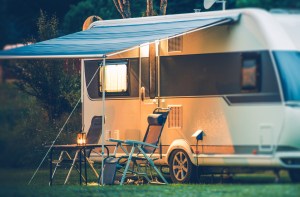
Now I would welcome a pop-up camper. It may have minimalist beds, but they are off the ground. Even a camping trailer would be nice. Those tents never really kept out the rain anyway and, given the choice, I would much rather sleep under a dry blanket than in a sodden sleeping bag.

(I’m still not completely sold on the huge RVs. I think of them more as a way to see the country than as a way to camp. Though they might be good for families with children and grown-ups even older than I.)

And now we have “glamping,” an ugly portmanteau word of “glamor” and “camping” that touts luxury and style. While glamping you can sleep in comfortable lodges or huge tents fitted out with full-sized beds. With throw pillows, even, in one of the photos I’ve seen. Wikipedia says it offers “the luxuries of hotel accommodation alongside ‘the escapism and adventure recreation of camping.'” “Resort-style services” may be available as you bask in Bali or indulge in a photo safari. In other words, camping for spoiled rich people. I know the rustic-looking cabins with all the comforts of the Waldorf promise a lot, but I can’t help feeling a little like I did as a naive and sturdy Girl Scout.

That’s not camping.


How the World’s Crappiest Typist Got a Job Typing

Actually, I am probably not the world’s very crappiest typist. I don’t use two fingers in the style called “hunt-and-peck.” (Except the one time I had to use a Cyrillic typewriter to write our Russian vocabulary lists. But I digress.) However, I am certainly among the worst.

As a kid, I played with an antique typewriter like the one pictured here. (It wasn’t quite so antique then.) I think there was even a typing manual that went with it, but my sister and I ignored it. We just had fun clacking the little buttons and seeing if we could hit multiple keys at once and cause a traffic jam up by the ribbon.

I might have learned real typing in high school, but I didn’t. Back then, there were different “tracks” of courses for students thought to have different job potential. Typing, along with shorthand and bookkeeping, was in the “secretarial” track curriculum. (They didn’t call it “keyboarding” back then.) I was on the “college prep” track. Evidently, the powers that be thought that college students didn’t need to know how to type.

I learned how wrong they were when I entered college as an English major. A plethora of essay assignments awaited me and all of the professors wanted them typed. (Admittedly, when I became a college teaching assistant, I required the same, having by then learned from my husband just how illegible human handwriting can be.)

So I got myself a portable typewriter and, armed with that onion-skin paper called Corrasable Bond and a jug of Wite-Out, I began to develop my peculiar typing style. (When typewriter ribbons started to include a white correction segment, I was overjoyed.)

But that was the extent of my typing experience. Over the years I learned to use about four to six fingers (including thumbs) to type, all the while looking at the keyboard instead of the paper or screen like I know you’re supposed to. Memorizing QWERTY seemed beyond me.

Then suddenly, when my freelance writing jobs started coming fewer and farther between, I knew I had to find another way to make some money. And because I was by that time used to working at home in my pajamas, my options were limited.

Finally, I noticed an ad for a work-at-home transcription service. They needed typists and proofers. “Hey!” I said. “I’m a pretty darn good proofer after all those years as an English major and a writer and editor. Why don’t I give it a try?”

While I was still in proofer training, however, I figured out that transcribers made, if not the big bucks, at least larger bucks than proofers. The job required listening to audio files and typing everything that was said into a document, proofing it myself, then turning it over to the actual proofers for final scrutiny. I asked to become a transcriber. But could I do it?

Fortunately, there was no actual typing test where I would have to produce so many words a minute without mistakes. (There probably should have been.) The bosses seemed more interested in whether the applicants had trouble understanding foreign accents.

That indeed is one of the major hurdles in transcription as a job. The audios we transcribe are almost universally boring meetings of business people or lawyers. Half the businesspeople have accents and more than half the lawyers mumble. A couple of times I’ve transcribed podcasts (though they were about business topics) and once a series of interviews with an actor promoting his latest TV series. But that’s been about it for interesting material.

And my six-fingered-and-thumbed typing has been good enough, at least to work part-time. It’s kind of appalling how slow I really am and how long it takes me to transcribe 45 minutes of audio, starting and stopping the little foot pedal that controls it, and often “rewinding.”

But I must be getting better. At least part of the time now I can type-excuse-me-keyboard while looking at the screen instead of my wayward fingers.

Magic in the Kitchen

It’s amazing what you can find in a kitchen. I admire people who have matching containers for flour, sugar, and mixing spoons. They usually also have kitchen gadgets that I can’t even name, let alone operate. Then there’s the ubiquitous kitchen junk drawer, which as a friend of mine noted, contains “rabies vaccination tags for cats that ran away” and “a dozen mangled twistie ties from last year’s Wonder Bread.” (He also called it “The Mother of All Clutter” and “Perfection’s Perfect Safety Valve.”)

But the most amazing thing you can find in the kitchen is a new life. A new start. A new purpose. Redemption.

I first realized this when my husband and I were watching the TV show Chopped. We couldn’t remember the names of the contestants, so we gave them nicknames: Who’s getting chopped this round? Red-beard guy! No, kerchief lady! Pickles everything dude! (We do the same with Forged in Fire. Santa Claus guy! Teenage upstart! Tattoo-neck! But I digress.)

One night there was a man on Chopped we took to calling “The Old Drunk,” because he was, well, old-looking and called himself a drunk when the judges asked him to tell a little bit about himself. He told how he had spent years as a hopeless alcoholic and how, after he got sober, cooking had saved him. I don’t remember whether he won Chopped, but now, I understand, he has cooking videos on YouTube and has appeared on other Food Network shows like Beat Bobby Flay. He seems to have done pretty well for himself on his journey up from rock bottom.

Then I started noticing other contestants with equally compelling stories. There have been more than a few who have credited cooking with saving their lives or giving them a way out of alcoholism or other addictions. Men have said that their lives started in gangs or ended in jail until they discovered cooking. One woman said it helped her escape from domestic abuse. Any number have said that cooking helped them feel pride in themselves when their families disapproved of their lifestyle or career choices. And quite a few competitors have said they used cooking to help overcome challenges such as anxiety, bipolar disorder, and other physical and mental difficulties.

This is not something that occurs only on TV, either. My husband used to work in community-based corrections. (And no, that’s not where we met.) As he counseled prisoners (inmates? clients?), he routinely heard that there were two professions that they wanted to explore when they were back on the streets: hairdressing and cooking.

(I don’t think there are any competitive hairdressing TV shows, but as soon as I say that, someone is bound to prove me wrong.)

What makes cooking such a redemptive pursuit? I think there are several answers. Cooking takes time, attention, and creativity when it’s done well. Even non-professional (or non-competitive) cooks can take pride in the idea that they are nourishing someone else – or even themselves.

I’m not saying that cooking will solve all a person’s problems or replace AA. But I do think that cooking, whether it’s at the level of professional or amateur, art or craft, hobby or necessity, speaks to something vital inside us. Food is necessary for life, after all, and making that into something expressive and loving and creative is transformative, of both the food and the self. It feeds not just bodies, but sometimes the soul.

I’m not sure about Forged in Fire. I don’t know whether bladesmithing is a redemptive act, too, though I imagine if done with sufficient commitment, pride, and artistry it could be. The same is likely true of many of the other competition-type shows. (Except Cupcake Wars. I may be wrong, but I can’t imagine anyone redeemed by cupcakes.)

One of the best-selling cookbooks of all time is The Joy of Cooking. I think it’s the joy as well as the struggle, the stumbles and disappointments, the cuts and burns, the standing rib roasts and the fallen soufflés, that give cooking its power to feed us all, and especially those who practice it with passion.

And those people I really admire, whether they’ve got their canisters in a row or not.


Cat TV and Other Amenities

Moving is always a challenge. Moving with cats doubly so. Yet, we have accomplished it thrice in a month. And all of us, feline and human, survived. Not necessarily happily, but we survived. The cats were the least happy of all and we tried our best to remedy that situation.

When our house was destroyed by a tornado, at first the cats had to remain in the shell of the house, as we were unable to get them out until the way to our front door was cleared of some of the fallen trees and other debris. (There was a crap-ton of debris.) We made journeys through the wreckage every day to bring them food and water until we were finally able to stuff them in pet carriers and rescue them. They did not appreciate the abrupt transition.

They went from chaos to indignity. The motel we were staying at did not allow pets, so they boarded at the vet, where they were looked after, given shots and medication, and the occasional pets and skritchies any time a worker came through the door. It was better, but still not ideal. From a home to an entire wrecked house to roam in, they saw their environs shrink to cages.

The next hotel we stayed at was pet-friendly, though they were dubious about cats. As they began to waffle (“I dunno…”) I whipped out the paper they had made me sign. With my patented wide-eyed, innocent look, I pointed to the place on the form that specified dogs, cats, birds, and fish as being welcome, though subject to a surcharge in case of damages. (Try and tell me they wouldn’t take cats! We saw mostly dogs around the hotel, though I suppose birds and fish might have escaped our notice.)

We humans suddenly had amenities we had been missing – a huge TV, kitchenette and its accouterments, a laundry on the third floor. But for the cats, there was little in the way of normalcy or entertainment. We bought them scratching pads, which were moderately successful in keeping them from damaging the furniture. My husband put small potted plants on the windowsill where they could knock them off while admiring the fifth-floor view. And they loved the bed, where they took up residence. But all in all, there wasn’t much for an active cat to do.

At last we moved to a rental house nearby. Suddenly the cats had, if not what they had at our original house, a fair facsimile. The first thing my husband bought for the new place was a bird feeder, which he positioned squarely in front of the living room windows. Voilà! Cat TV and an opportunity to play “I wanna bite the birdie.”

Then Dushenka and Toby started exploring the house, busy-nosing and pussy-footing everywhere until they determined their favorite spots to crash. One was the multi-level cat tree, placed thoughtfully within viewing range of the all-bird channel. The other, of course, was our bed.

We knew the cats felt at home when Dushenka was brave enough to go walkabout. Scooting out a poorly guarded door, she led us all around the neighborhood, inspecting people’s yards, and cars, and gardens, as well as a stand of thick brush and fir trees that we humans couldn’t penetrate. We tried tempting her with food and water, to no avail.

Finally, we gave up. We were exhausted and decided to go home and make Wanted posters. As soon as we headed back to the house, there she was, following Dan trot-trot-trot down the street and into the house, since the game was clearly over. We told her she was a naughty girl and in disgrace, which she completely ignored.

Moving so many times within such a short period, a matter of weeks, was hard on us, but we tried our best to make it easier for the kitties. After all, their comfort was the most important. Just ask them.


Retirement and Reality

I officially retired last year, when my birthday hit the federal standards, and I’m here to tell you, it’s not all it’s cracked up to be.
The commercials on investment – sorry, “wealth management” – would have you believe that retirement means a lot of opening your dream business, building your own Wright flyer, and washing elephants in Africa. (Or maybe India. I didn’t get a close look at the elephant’s ears. But I digress.)

What I’ve found is that in retirement, not much has changed for me. Oh, I get a modest infusion of cash every month via Social Security, which is certainly more than welcome. But I haven’t been able to quit my job. It’s freelance – not the sort of job that boasts retirement benefits. And the 401k from when I did have a job like that is long gone, eaten up by a voracious spell of unemployment owing to health problems.

What this all means is that life before and after retirement are markedly similar. I still work that part-time freelance job (which is not, thank God, over the limit for what a person on SS is allowed to earn). I still have to forego foreign travel. I take surveys to earn enough points for dinner at a nice place (within a very limited definition of a nice place). At the end of the month, I doubt my decisions on how many cable channels are enough. I have to buy my wine at Aldi.

Of course, there are benefits. The federal government sees to that (so far). That deposit that appears sporadically between the 9th and the 16th of the month (don’t ask me why) makes a huge difference in my lifestyle and my nerve endings. I am indeed grateful that I do not (yet) qualify for SNAP benefits as well. I am able to pursue my hobbies of yelling at whippersnappers and waving my cane at them.

I know it’s idiotic to use television and as a standard of what life will be like, but I can’t help looking at all the TV shows and commercials. Retired people romp with their grandkids and even babysit them (I don’t have any grandkids and likely wouldn’t babysit them if I did). They play golf, a “sport” I detest. They invest. They have fulfilling sex lives. Their dentures fit. (I don’t have dentures, but it’s the idea of the thing that’s important here.)

Of course, I wouldn’t know what to do with that sort of retirement if I had it. Work has become a habit after these many years and, though I’m sure I wouldn’t miss not doing it, it provides a sense of purpose and familiarity. I traveled when I was younger and could get around without a rent-boy to carry my luggage. There are still places I would like to see, but the places I have been were pretty amazing. If I had the choice to save that money (and I suppose I did), I wouldn’t. Perhaps when and if my memories grow dim, the sights I’ve seen will become distant blurs. But having had the experiences is something that I treasure.

And really, I am blessed, even in this not-quite-idyllic retirement. I still have my husband and we have our cats. We have a roof over our heads and food on the table. We have friends and family and an assortment of other things that, as they say, money can’t buy. I know that not every person of my age and state of life can say the same. (And there is something wrong with a system that lets that happen.)

So, even if I don’t have the golden-sunset vision of retirement, I am largely satisfied with what I do have. Someone else will just have to wash those elephants’ ears. I’ll make do with the kind they have at the local bakery.


Our House Is a Very, Very, Very Weird House

We moved into a rental house to wait for our old house to be rebuilt after a tornado. And man, is it weird. And old. Not farmhouse old or historic place old, but 50s ranch-style old.

How did we know it was that old (aside from reading the listing)? When we moved in, we asked the furniture rental company for three TVs and two computer desks. These they promptly supplied. Then we found out there were no cable outlets in any room. Presumably this house had been occupied before, but evidently, none of those families watched TV or went online. Weird. It took the cable guy five hours to fit out the house with all the outlets we needed.

The layout of the house is also weird. The front door opens onto the dining room, just steps away from the kitchen, which is also the laundry room. The washer and dryer sit opposite the fridge, sticking partway into the actual kitchen space. Next to them, for no apparent reason, is a foot-wide patch of countertop and then the stove. The microwave is next, taking up most of the rest of the counter space. The cabinets look fine from the outside but are unfinished inside. Shelf paper is definitely called for. (Remember that movie Johnny Dangerously, where Marilu Henner says, “Oh, Johnny, I love shelf paper”? I never thought I would find myself agreeing with her, but here I am. But I digress.)

Down a short, narrow hall (all the halls are narrow) is the living room, which is at least a cozy but decent size and has three windows overlooking the backyard, where my husband can put some bird feeders so as to have cat TV (no cables required for that).

The bathrooms are also weird. The master bathroom is actually the half-bath. The full bathroom is off the hall a ways down. Both are tiny. Evidently, we’re supposed to shower, then drip back to the bedroom to dress. It might be quicker to go to the kitchen and pull clean clothes out of the dryer.

The weirdest part of the house is a big empty room also off the dining room, which is billed as “a family room or even a fourth bedroom.” It is bigger than the master bedroom, but it has a tiled floor and the only door that leads to the backyard. Plus the only three-pronged outlets in the house. Right now we’re using it as the cats’ bathroom. Litter room. Whatever. (They bathe anywhere and everywhere.) I suppose we could get a ping-pong table and designate it the game room. Maybe even teach our cats to play ping-pong like those ones on the internet. Which we can now connect with.

The house is not without its charm. It is in a nice, secluded neighborhood of similar vintage houses, but not too far from the main drag, which has a convenient drugstore, a pizza parlor that delivers to us, and a Kroger’s a little further down. There’s an entrance to the highway within a reasonable distance, too. Even an establishment (I don’t quite know what to call it) that offers doughnuts, ice cream, and free wifi, and a Dollar General, which I imagine we’ll be frequenting for all the little stuff we don’t now own and the rental company didn’t provide. (They provided an astonishing variety of things – even kitchen utensils, including a whisk. I’ve never owned a whisk. If anything needed whisking, I forked it instead.)

The house does come with some nice amenities: an attached garage; a shed out back; central air; ceiling fans in the dining room, living room, and master bedroom; and two smaller bedrooms, which have become our home office and study.

We’ll likely live here about a year while our own house is rebuilt. We’ll probably find more curious things about it as we do, but we think we can be comfortable here. After all, the house may be weird, but so are we.


Living Large in a Hotel

You know all those movies from the 30s where people live in hotels and call for strawberries and champagne and poof! they appear at their door? Well, life in a hotel is not exactly like that, but it does have its moments.

We’re living in a hotel now not because we’re wealthy socialites or retirees looking for an alternative to a nursing home, but because our house was destroyed in a tornado and this is what the insurance company has set up for us. So, first of all, living in a hotel beats the hell of living in a Red Cross shelter, though we were very glad that there was one available the day the tornado hit. They provided hot meals (our current hotel provides hot breakfasts) and purchased us new underwear (which our current hotel has yet to offer).

When we left the accommodations at the First Baptist Church of Kettering, welcome as they were, we set up at a motel right across the street from a McDonalds. We were assigned a suite and later moved to a nicer suite. Both offered a fridge/freezer, microwave, cable TV, and USB ports in the electrical outlets, an amenity which we did not expect but greatly appreciated, what with all the telephone calls we would be making and receiving once we retrieved our cell phones.

Unfortunately, this microscopic motel did not allow pets, so our two cats were put up in a different facility, our vets’ boarding kennel. There they received three squares a day, a cozy room each, and all the loving they could con out of the attendants, plus shots and treatments for the various indignities they had suffered. In some ways, particularly the pets and scritchies, they were better off than we were.

Later, the insurance company moved us to a pet-friendly inn for residence, where we remain to this day (two weeks after the tornado struck). This is a semi-proper hotel. Not that the other was an improper hotel, the kind we spent our wedding night in. But this one features full breakfasts rather than Continental, plus mixers with appetizers three nights per week.

No strawberries and champagne, alas. There is no room service unless you count the local pizza parlors that service the establishment. No cocktail lounge either. But the kitchenette is improved by a full-sized refrigerator/freezer, a cooktop, and a dishwasher in addition to the microwave.

When I traveled with my mother to Rio back in the day, she was delighted by the wee room service amenities such as tiny pots of jam and decanters of cocoa, which she had never encountered before. This hotel equips the guests with not merely soap and shampoo, but small packets of salt and pepper, dishwashing liquid (to go with the plates, glasses, pots and pans, and other kitchen paraphernalia), paper towels, can opener, corkscrew – nearly everything a patron could wish. (The front desk sells laundry soap and there is a coin laundry on the third floor.)

Then there is the housekeeping service. I actually have no problems with this service – they even start the dishwasher if there are enough dirty dishes (though I’m not sure what quantity that is). The problem I have is with my husband. We could never have a maid at our home because (aside from the cost), the house would never be clean enough for a maid to come in and clean. He has a similar problem with the housekeeping staff, which means that we are piling up used paper towels, kitty litter (and barf), and such detritus until such time that enough of these items disappear that the housekeeping staff would not be appalled to vacuum our floors and change the sheets.

All in all, I can’t complain about living in a hotel, though when we move to a rental house (perhaps next week), we will have to make numerous trips to transfer all the clothes, food, and other accouterments that we have acquired during our stay. The bag of potatoes, for example, not to mention the laundry, both done and undone, could easily comprise a single load.

It’s been worth not having champagne and strawberries at our beck and call to have a safe and comfortable place for us and our kitties to recover and feel at least a little more normal. It will be a relief, though, to have a place, even if not our own, to spread out a bit more and resume our habits of daily living and not have to worry about the maids’ opinion of them.

The Naked Audience

I had a public speaking engagement coming up. In fact, my publisher had arranged to have me do a reading/signing of my first book, Bipolar Me, at the local Barnes & Noble.

I do suffer from anxiety but, perhaps surprisingly, this did not have me paralyzed with fear. For one thing, I had supportive friends. Although the most common advice given to people who do public speaking is to picture the audience naked, a friend of mine offered to picture me naked instead if I thought it would help. And my husband offered to stand in the back of the room and shout, “Show us your tits!” if I started to freeze up. Such helpful friends I have!

Perhaps the reason that public speaking doesn’t terrify me is that I studied speech and debate in high school. Once you’ve been in an extemporaneous speaking contest and drawn the topic “If a chicken had lips, could it whistle?” there’s little that can daunt you in the future. (For those interested, I said, no, it could not.)

I also have some experience teaching college and business school English. Sometimes this endeavor was fraught with peril. Once I was teaching a lesson based on a reading about AIDS and one of the students informed me she had heard that it started in Africa with people “messing with monkeys.” I told the class that I denied that was what happened.

One student piped up, “People do screw sheep, you know.” (He did not say “screw.”) I knew this was meant to disconcert me. “Mr. Chadwick,” I replied, “can you please tell us what disease you can get from screwing sheep?” (I did not say “screw” either.) He did a perfect spit-take, the only one I have ever caused or indeed seen in real life.

(I referred to my students as Mr., Ms., or any other courtesy title they were entitled to, on the theory that if they were required to call me Ms. Coburn, I should extend the same dignity to them. But I digress.)

I had even done public speaking at business functions. Once I had to address a group at a power breakfast meeting, introducing a new magazine that the publishing company I worked for was launching. I even opened with a joke. (“I thought that since we’re launching a new magazine, I should open with a toast. My husband said, ‘A toast? At breakfast?’ ‘Okay,’ I said, ‘how about cinnamon raisin toast?'”) There were gratifying chuckles.

Another time, I was asked to give a humorous talk at the retirement dinner of my boss. (Again, my husband was prepared to stand in the back and heckle.) I borrowed a technique I had seen used at a business conference and created an imaginary slide show. I used one of those little clicker gizmos that nuns used to carry in Catholic schools to “advance” the slides and then described whatever scene I wanted to set up a punchline. (“Here’s a picture of Carl dressed as The Big Bad Wolf for Halloween. The next day he called in sick with distemper.”) Afterward, they gave me $100, so I suppose now I can call myself a professional stand-up comic.

My Barnes & Noble talk, though, didn’t exactly go off without a hitch. Only two of my friends showed up (plus my husband). Luckily the event was held in the bookstore’s cafe and I managed to suck in a few patrons, especially during the question and answer session. I had to skip my introduction, as the audience already knew me, and cut my joke, too. (“What is bipolar disorder like? It’s like sex. You can’t adequately explain it to someone who’s never had it.”)

Anyway, I counted the appearance as a success. I read a few short pieces from my book, which I had cleverly printed out in large type beforehand so I wouldn’t squint. I signed a book for one of my friends and a bunch for the store so they could put “Signed by the Author” stickers on them. One member of my accidental audience asked for my autograph and a few words of wisdom, though she didn’t buy a book.

And the store said they’d be glad to have me back when my second book, Bipolar Us, comes out later this year. No joke.

State of the Arts

It bothers me that the two trends in art that are gaining the most ground nowadays are prettiness and functionality.

Prettiness and functionality have their place in art, of course. Who doesn’t love a Monet landscape? And Soviet Realism, while hardly pretty, performed its function of representing the worker as hero and inspiring comrades to greater effort.

But prettiness is not beauty. If you look beyond the prettiness of a Monet, you see the sheer talent that it took to break the boundaries of then-current art standards and paint in a way that revealed a different way of looking at the world. And that was beauty.

No one would call Picasso’s Guernica either pretty or beautiful. Its clashing shapes and tortured figures do not inspire “awwws.” They aren’t meant to. The painting is a condemnation of the horrors of war, and it performs that function exceedingly well.

Now, I don’t have anything against art that is pretty or functional. I just think that there is a lot more to art than just those qualities.

But art today – or at least what passes for art – is solely about prettiness and functionality. The National Endowment for the Arts, an independent federal agency, was established to “fund, promote, and strengthen the creative capacity of our communities by providing all Americans with diverse opportunities for arts participation.” Now the organization’s existence is in great doubt. The federal budget eliminates it completely (though it hasn’t passed yet).

Why the neglect of the NEA? It isn’t pretty enough. It isn’t functional enough. It supports and promotes a variety of types of art, some of which are challenging, unappreciated, and even shocking. At least that’s what the budgeteers focus on. The NEA, however, also provides grants for projects like arts education in communities and schools, including “the growth of arts activity in areas of the nation that were previously underserved or not served at all, especially in rural and inner-city communities.”

Why, the NEA even collaborates in a program with “more than 2,000 museums in all 50 states that offers free admission to active-duty military personnel and their families during the summer.” But you (and apparently Congress) never hear about things like that.

Arts education in the schools is languishing too. Along with music, it’s been relegated to the heap of the “unnecessary” or watered down to become “art (or music) appreciation,” with little or no thought given to allowing children to create their own art as well as studying “the masters.” It’s like art is now an extracurricular, though not as well-funded a one as sports.

STEM is the current bastion of functionality in school curricula. And admittedly, the U.S. needs more citizens educated in technical fields such as medicine, aeronautics, robotics, engineering, architecture, and so on. Art occasionally sneaks in there, so the programs reluctantly become STEAM, but the focus is still on turning out people who perform what most people consider vital functions in our society – those associated with products, and industry, and money.

But art, even when it’s disturbing, does have a function. It can make us think, love, cry, wonder, or remember. Imagine a world without art. No music, no dancing, no paintings, no sculptures – not even any graphic design. (That would mean no political campaign posters.) Life would be very different and much duller. Even if you don’t believe it, the arts touch you in some way every day of your life.

The arts are far from being a waste of time and money, as some seem to think. Winston Churchill had it right: “The arts are essen­tial to any com­plete national life. The State owes it to itself to sus­tain and encour­age them….Ill fares the race which fails to salute the arts with the rev­er­ence and delight which are their due.”


Dressing Up and Dressing Down

Recently, there was quite a flap in Houston, TX, that quickly went viral. It seems that the administration of James Madison High School had issued a dress code. For parents. Apparently, there had been a problem with parents who came to the school inappropriately dressed.

I had my own experience with restrictive dress codes, though it was not at school (once the administration decided that girls could wear slacks). No, this was at a job I once held.

One day Doris, the HR/accounting person, sent around a memo that prohibited the wearing of shorts or tops that did not cover the hips, as with leggings.

I immediately demanded clarification.  “What about skorts?” I asked. “And culottes? How do you tell when something is baggy shorts or an actual culotte?” (I had no intention of wearing shorts, skorts, or culottes.)

“And what is this about your top must cover your hips? Don’t you mean it must cover your ass?” I inquired. Doris protested that the two meant the same thing.

“I don’t know about you,” I replied, “but my ass is a lot lower than my hips.” (It’s even lower now.)

Doris shooed me out of her office.

But I was not to be thwarted. I kept running back to her all day with requests for clarification. “Pedal pushers? Are those allowable? Gaucho pants? How about palazzo pants?” I kept it up all day, much to the amusement of my coworkers. As far as I could tell, no one changed their style of dress based on Doris’s admonitions. It was not really a concern for me, as I habitually keep my ass, as well as my hips, securely covered. And I don’t even know anyone who owns palazzo pants.

The brouhaha in Texas was a different sort of dress code, however. The school prohibited trespassing on their sacred precincts wearing a variety of attire including satin caps or bonnets, hair rollers, pajamas, leggings, low-cut tops, sagging pants, short-shorts, and “dresses that are up to your behind.”

But these were not rules for the students (although I imagine they had to follow similar ones). These strictures were for parents. In point of fact, moms. Except for the sagging pants, dads were unlikely to appear at school in any of the banned clothing. Probably.

Although it sounds amusing, this was a very serious thing. One mother was even reported to the police when she showed up at the school wearing a t-shirt dress and a headscarf. She naturally asked to see a copy of the dress code in writing, and the following day one was sent out.

Some viewed this policy as an affront to African-Americans, who evidently see nothing wrong with headscarves or satin caps. And I have no information on whether the rules were as strictly enforced on white moms as well. (I do know that bandanas, aka headscarves, have been traditional bad hair day accessories for all races for decades. Maybe even centuries.)

I can perhaps see a school not wanting visitors to enter the actual building wearing pajamas and bathrobes. But for all those moms who must get their kids to school at some ungodly hour, then return home and get dressed and ready for work, the temptation to cut corners must indeed be great. I picture the crossing guards at the drop-off car parade scrutinizing drivers and issuing citations for unapproved curlers.

It’s a good thing most moms don’t have to get out of their cars to deliver their kids to school. There might be a Doris waiting to measure the altitude of their ass and debate the propriety of palazzo pants.