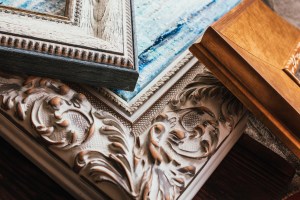
 “I don’t know art, but I know what I like” is an old saying that expresses what many people really feel about art. Unfortunately, what they like is seldom art. More like dreck or kitsch. Maybe not sad puppies, but over-the-sofa mass-produced art. “Art” that doesn’t evoke thoughts or feelings: wonder, awe, challenge, mystery, inspiration, anger, sexuality, tenderness, memory, questions, fascination, laughter, pity. “Art” that doesn’t take you outside of yourself or into yourself.
I did learn a little about art in school – mostly the Impressionists (and a little about the Fauvists) because I was studying French at the time. Later on I learned a bit about cubism, pointillism, and a few other -isms. Still, most of the art hanging in my house is simply what I like.
Oh, I had a Van Gogh Sunflowers poster in my college dorm room and was thrilled beyond words to see the original (or one of the originals) in the Philadelphia Art Museum. Seeing the almost sculptural aspects of the brushwork made me unable to be satisfied with a flat poster ever again.
But gradually, the artwork surrounding me has become more … idiosyncratic.
This was brought home to me recently when, after a natural disaster, most of the many artworks that graced our home were assumed lost. We never knew just how much our artworks meant to us until they were gone. They had become such a fixture in our house that we didn’t really appreciate them as we did when we first acquired them. And that was a shame, because losing them left a distinct hole in our lives.
The rental house that we moved into was entirely devoid of decoration. There were flat, neutral walls; flat, neutral carpeting; flat, neutral furniture. I know they have to make rental houses this way to appeal to renters with various kinds of furniture and taste, but we had nothing to take the edge off all those neutrals. Nothing relieved the eye.
Our “art collection” was nothing elaborate or expensive, but it had meant a lot to us. A large part of my contributions to the household decorations consisted of paintings by Peggy McCarty, a talented friend of mine. These included self-portraits, paintings of food, and a couple of paintings of me or one of our cats, as well as a tiny landscape refrigerator magnet.
Dan collected many posters and prints, some of them signed and numbered, at the science fiction conventions we went to. These featured moody or majestic planet-scapes; cacti bursting off the ground like prickly green rockets on pillars of flame; wizards, changelings, and such; and a carved head of Einstein. Not all of them were to my taste, but, as the saying says, he knew what he liked. And some of them I found stirred my heart as well.
Not that my contributions to our household artwork were all formal and highbrow. One framed poster that Dan got for me was the theatrical poster from the Puss in Boots movie, which had a prominent place on our bedroom wall. The bright orange and yellow background demanded you notice it and, well, I’ve always had a thing for anthropomorphic cats.
Not long ago, we discovered that a number of our beloved artworks had survived the tornado. Some of the unframed, unmatted ones had sustained damage and others still haven’t shown up. But I was so happy to see the ones that did, I almost cried.
Naturally, we went right out and bought a bunch of Command Hooks (“Do. No Harm”) and started alleviating all the neutral walls with things that remind us of our old home while we wait for it to be rebuilt.
My study (actually the small bedroom) walls are graced by four small works: one of apples painted on a board by my artist friend Peggy; a print of a metal tiger from the Chinese Soldiers exhibit at the local art museum; a colorful Debbie Ohi sketch with a Neil Gaiman quote that I won in a raffle; and a framed, round, black-and-white drawing of a cat on a branch with stars in the background.
We each selected one work for special placement in the living room. Dan chose a framed poster of “To Everything There Is a Season” that used to hang in his office. I chose Peggy’s painting of Dan’s first cat, which I had commissioned her to paint for him for his birthday one year.
We haven’t settled on what goes in the master bedroom yet, though there is an evocative blue and white framed print that has a good chance of making the cut. So does Puss in Boots, though it will clash terribly.
But I know what I like.
 Our house felt remote, surrounded by trees and a small stream and prairie grasses and wildflowers. Our neighbors were remote enough that we could have become practicing nudists, were it not for the invention of telescopes. Actually, it was very close to everything required for modern life.
 A while back, I wrote a blog post (
 I knew a woman once who, when she was at business conventions and besieged by requests, saturated with meetings, and overwhelmed by the exhibit hall, stated that she had to retreat to her hotel room “to rearrange the furniture in my head.” I thought that was a great way to put it. We all have furniture in our heads and sometimes it’s necessary to place it in areas where we won’t trip over it and bruise ourselves. Or there may be more furniture than we need and we must jettison some of it.
 I saw a meme the other day that defined the laundry cycle as wash, 45 min.; dry, 60 minutes; fold and put away, 7-10 business days. That would be optimistic for me and my husband. We are useless people.
 There we were, bedding down on sleeping bags in our tents, the cold, hard ground only a layer of canvas or plastic away. When we sprang out the next morning, our lithe teen forms dressed in green shorts and Vibram-soled boots, we hoisted our backpacks and hiked over hill and dale and rocky trails, singing optimistic songs and breathing deep of the fresh air. We ate granola as we walked.
 Actually, I am probably not the world’s very crappiest typist. I don’t use two fingers in the style called “hunt-and-peck.” (Except the one time I had to use a Cyrillic typewriter to write our Russian vocabulary lists. But I digress.) However, I am certainly among the worst.
 It’s amazing what you can find in a kitchen. I admire people who have matching containers for flour, sugar, and mixing spoons. They usually also have kitchen gadgets that I can’t even name, let alone operate. Then there’s the ubiquitous kitchen junk drawer, which as a friend of mine noted, contains “rabies vaccination tags for cats that ran away” and “a dozen mangled twistie ties from last year’s Wonder Bread.” (He also called it “The Mother of All Clutter” and “Perfection’s Perfect Safety Valve.”)
 Moving is always a challenge. Moving with cats doubly so. Yet, we have accomplished it thrice in a month. And all of us, feline and human, survived. Not necessarily happily, but we survived. The cats were the least happy of all and we tried our best to remedy that situation.
 furniture. My husband put small potted plants on the windowsill where they could knock them off while admiring the fifth-floor view. And they loved the bed, where they took up residence. But all in all, there wasn’t much for an active cat to do.
 I officially retired last year, when my birthday hit the federal standards, and I’m here to tell you, it’s not all it’s cracked up to be.
